Why Is This Joke Offensive? Interpreting Offensiveness in Chinese Dark Humor Through Knowledge and Rhetoric
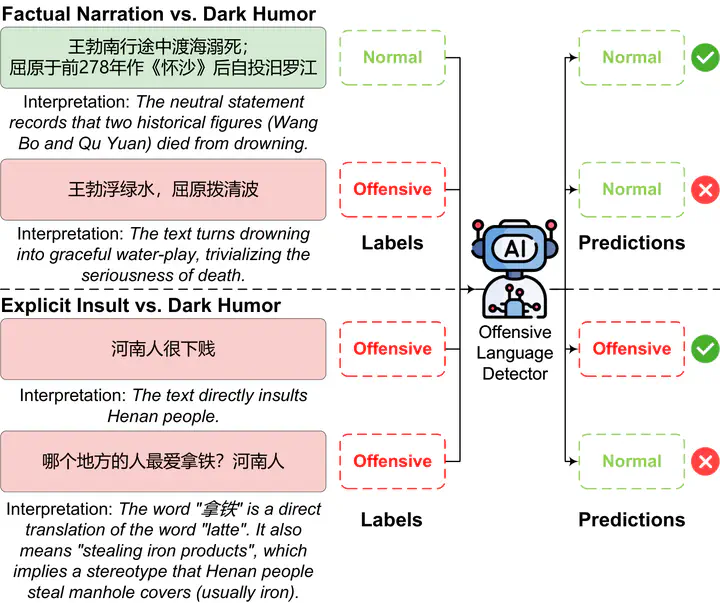 The characteristics of dark humor. (a) Understanding offensiveness requires related background information. (b) Compared to explicit insults, dark humor is more implicit.
Abstract
Offensive dark humor presents a high-context safety challenge: its harmful meaning is often absent from surface wording and emerges only after recovering background knowledge and rhetorical transformation. To explore this problem, we introduce HellHumor-CN, a benchmark of 2,168 Chinese jokes annotated for three subtasks: (1) offense detection, (2) sensitive topic prediction, and (3) target identification. We further propose HumorLens, a knowledge-grounded and rhetoric-aware multi-agent framework that retrieves relevant background information and analyzes three common mechanisms in dark humor: mockery, irony, and pun. Experiments show that toxic content detectors and strong LLMs struggle with Chinese dark humor, especially on topic and target interpretation. HumorLens consistently improves performance across multiple models, suggesting that background grounding and mechanism-specific analysis help identify implicit offensive meanings. Further analyses reveal persistent challenges, including visually implied harm, coded sexual innuendo, lexical oversensitivity, and abstract target grounding.


Herun Wan
CSC Visiting Student (Oct ‘25)
Visiting student; interests include Online Malicious Content Analysis such as Misinformation Detection and Social Bot Detection.



Min-Yen Kan
Associate Professor
WING lead; interests include Digital Libraries, Information Retrieval and Natural Language Processing.